


Review Summary Editor's choice
Pros: very comfortable and smooth, close shaves, sturdy build quality, waterproof, travel lock, excellent battery life, easy to clean, useful accessories, 5-year warranty
Cons: large and somewhat heavy, no USB-C port
Last year, Philips finally rolled out a key product that had been missing from its portfolio: a rotary head shaver.
Called the Head Shaver Pro, it’s designed specifically for men who shave their heads themselves.
Given the extensive expertise Philips has amassed over the years with rotary (face) shavers, it was only natural to come up with a rotary for the head.

The demand for dedicated head shavers has grown exponentially over the past decade, with products like the Skull Shaver Pitbull becoming very popular.
However, many of these shavers, especially from newer, lesser-known brands, have had numerous quality issues.
When Philips first announced the Head Shaver Pro, there was genuine excitement about finally getting an effective and reliable alternative.
I tested the Philips Head Shaver Pro (9000 Series) extensively over the past few months, and in this review, I’ll share everything you need to know.

I’ll also compare it to other popular rotary head shavers, like the Skull Shaver Pitbull Gold Pro and the Remington Balder Pro.
But first, let’s take a quick look at the three Head Shaver Pro variations you can choose from.
Philips Head Shaver Pro comparison: 5000 vs 7000 vs 9000 Series
The new Head Shaver Pro is available in three versions:
- 5000 Series [Philips product page]
- 7000 Series [Philips product page]
- 9000 Series [Philips product page]
Here’s a comparison table that showcases the main differences between them:
| Model | Features | Price |
|---|---|---|
Series 5000 (HS5980/40) | 60 min battery, basic LED indicator, soft pouch, cleaning brush | Amazon |
Series 7000 (HS7980/40) | 90 min battery, basic LED indicator, rinse tub, travel case (hard), cleaning brush | Amazon |
Series 9000 (HS9980/40) | 90 min battery, 3-level LED indicator, rinse tub, premium travel case (hard), extra set of replacement heads, mirror, cleaning brush | Amazon |
The most important takeaway is that the shaving performance (closeness, comfort, motor speed, cutters) is identical for all three series.
The differences come down to accessories and some features that won’t directly impact the cutting performance.
That said, my picks would be either the 7000 Series if you can get it at a discount (it’s often on sale) or the 9000 Series if there’s no deal.
I think the price difference between the 7000 and 9000 Series (at full retail prices) is well worth it.
Philips Norelco Head Shaver Pro 9000

With the 9000, you get an extra set of replacement heads (that alone makes up for the price difference), a better battery level indicator, a better travel case, and a mirror.
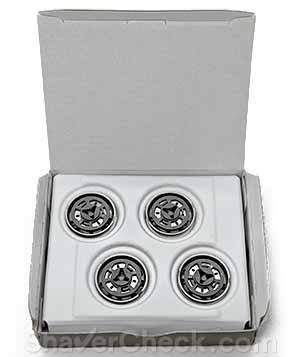
The 5000 Series, while just as good performance-wise, is probably not worth buying unless (again) you get a great deal on it.
It has a much smaller battery (60 min vs 90min) and only comes with a flimsy cloth storage pouch. The rinse tube is also not included.
I bought the 9000 Series (HS9980/40) as I felt it offered the most compelling package overall.
However, this review will also be relevant for the 5000 and 7000 Series, because despite these differences, they shave exactly the same.
Features overview
1. Four-blade flexible shaving head

As expected, a head shaver from Philips Norelco was bound to be a rotary.
Unlike their face shavers, which feature three rotary heads, the Head Shaver Pro gets four heads.
I think this choice makes perfect sense, and having used 3, 5 and 6-blade rotary shavers, 4 heads seems to be the best compromise.
The unit is large enough to be effective on a large surface like the head, but still manageable.
A 5-blade rotary like the Balder Pro is quite a bit larger and not as nimble.

More heads also means a more expensive replacement set, so again I think a 4-blade head was the most sensible decision.
The four cutters are mounted on semi-independently flexing holders, which is standard for entry to mid-range Philips shavers.
Fortunately, the cutters are suspended on tiny springs that flex with ease and are very effective at maintaining the cutters in optimal contact with the skin.

This makes shaving feel super smooth and pleasant.
Finally, the Philips guards and blades can be removed completely for easy (thorough) cleaning, something you can’t do with the Balder Pro, for example.

The whole Philips shaving unit can be detached (and replaced), and it also flexes (the so-called 360 Flex), but it’s not super useful, and the range of motion is limited.
2. Wet/dry, cordless only operation
All Head Shaver Pro models are IPX7 waterproof, so you can shave wet (even in the shower) with your favorite shaving gel for extra closeness and comfort.
It also means you can quickly rinse the shaver clean with tap water.
Like most current electric razors, the Head Shaver Pro will only work cordless.
You won’t be able to shave with the cord plugged in.
The battery on the 7000 and 9000 will provide around 90 minutes’ worth of cordless use, which is excellent.
3. Ergonomic design

What makes the Head Shaver Pro different from a regular rotary razor is its distinctive form factor.
It allows the user to comfortably grip it when shaving the top, back, and sides of the head.
A large rotary shaver with a conventional handle would be awkward to use.
There are basically two ways to grip the Philips Head Shaver Pro, and I’ll get into all the details in the next section of the review.
4. Warranty
Depending on the country, you can get up to 5 years of warranty if you register your Head Shaver Pro on Philips’ website within 90 days of purchase.
If not, you will get the standard 2-year warranty.
Build quality and ergonomics

The Head Shaver Pro, whether it’s the 5000, 7000, or 9000 Series, appears to be one of the better-built rotary head razors.
Having handled quite a few, there are some things that immediately caught my attention.
The part of the shaving unit that holds the cutters is very sturdy, clicks securely in place, and is easy to remove, even though there are no release tabs.

The bracket that locks the cutters looks and feels solid, and it’s a reliable system that’s been carried over from Norelco’s face shavers.
But the most important detail that hints at better reliability is how the entire shaving unit attaches to the shaver’s body.
The fitting is sturdy and solid, doesn’t wobble at all, and the plastic seems to be of excellent quality.

In contrast, the fitting on the Skull Shaver Pitbull is way less sturdy; it’s shallow and will wear out faster, even more so if you constantly remove the shaving unit.

The body of the Philips head shaver is made of plastic, and while a bit lackluster, it feels very durable.
Most of the panels have a matte finish with only a couple of high-gloss areas around the power button and the drive shaft at the center.

The body is purposely shaped so you can hold it comfortably while shaving your head.
And because there’s enough clearance between the shaving unit and the body, you can grip it in two ways:

The second one (2) is more useful for the back and top of the head, while the first one (1) works for pretty much any area of the scalp.
This Philips is one of the larger rotary head razors out there, and at 209g, one of the heaviest.
In comparison, the Pitbull weighs 197g, while the Balder Pro is the lightest at 187g.
Even so, gripping and using the Head Shaver Pro, even for an extended session, will be fine for most users.
Sadly, Philips didn’t add any rubberized grips or panels to these shavers.
Even the ribbed black part at the top is matte plastic (it only looks like rubber).
So the grip is not great, but unless the shaver is covered in lather (if you wet shave), I don’t think you’ll have any major issues.
The power button is positioned perfectly, and there’s almost zero chance of ever pressing it by accident.

And it doubles as a travel lock (activated via a long press), something we don’t see on most other head shavers.
Takeaway
Despite the bulky body and lack of a rubber sleeve, the excellent ergonomics of the shaving unit make up for most of these cons.
The durability seems to be superior compared to its main competitors, the Skull Shaver Pitbull and the Remington Balder Pro.
The Philips head shaver is still a fairly new product, so only time will tell. But the early signs are encouraging.
Included accessories

As we know, the bundle will vary with each of the three variations.
The 9000 Series that I bought comes with a very generous kit, and I think it’s the one to buy unless you can get a great deal on the other two.
Here’s what’s included with the 9000:
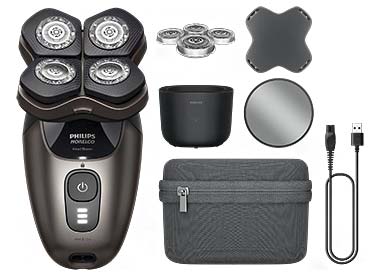
- Premium (hard) travel case
- Protective head cover
- Rinse tub
- USB-A charging cable
- Extra set of replacement heads
- Hand mirror
- Instructions leaflet (here’s the PDF version)
I was very pleasantly surprised by the quality of the travel case.
It looks and feels like an expensive product, it’s very sturdy and offers excellent protection.
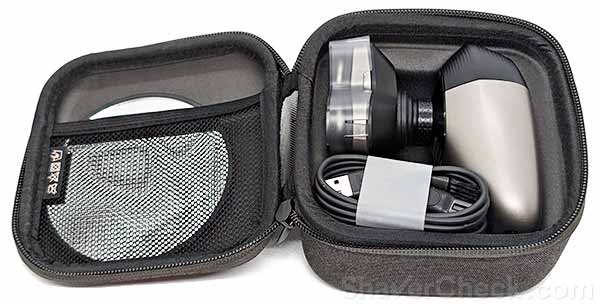
There’s plenty of room to accommodate the shaver, head cover, cable, and mirror.
Oddly, I couldn’t find the small cleaning brush, even though it’s depicted on the package and explicitly listed on the product page.
And it does exist (for all three series), as it’s confirmed by many user reviews.
Nevertheless, I always clean my shavers with water, so it’s not a big deal.
I think the 9000 Series mirror is a very thoughtful and practical accessory (and should have been included with the 5000 and 7000 series as well).
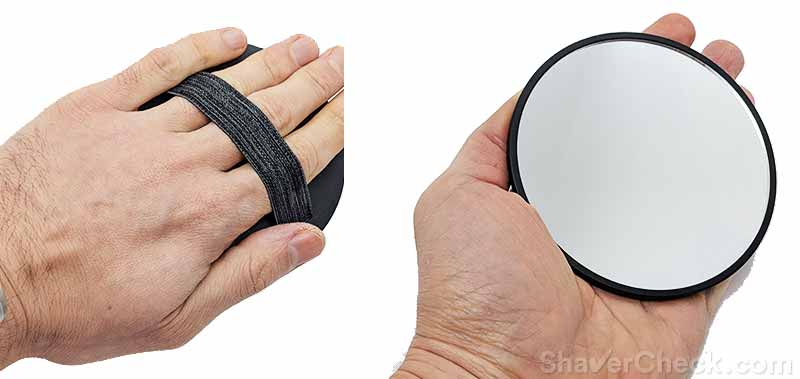
It’s extremely helpful as you can use it to see the back of your head in your main mirror.
I use a foldable 360 mirror, which is in my opinion a must-have and a game-changer, but if you don’t have one, the small hand mirror is good enough.
It even features an elastic band so you don’t have to constantly grip it.
This bundle makes the 9000 Series the most appealing Head Shaver Pro, and I think it’s well worth it if you have the budget for it (unless you can buy the 7000 Series for half the price).
Shaving performance
Let’s now see how the new Head Shaver Pro performs.
I will make various references to the Pitbull Gold Pro and Balder Pro as I think they could be worthy alternatives, and many users will be cross-shopping all three.
Closeness of the shave
The Philips Head Shaver Pro is a rotary machine fitted with 4 heads.
Rotary shavers are generally not the very best when it comes to closeness, as the metal guards are a lot thicker than foil screens.
Philips tries to compensate for this by adding a double edge to each individual blade (the so-called Lift&Cut system).

However, the blades that come standard on the Head Shaver Pro are very basic and only feature a single-edge blade.
(I will share a couple of blade upgrade options in the next section.)
But even so, I’m happy to report that the closeness of the Philips Head Shaver Pro was excellent, at least on par with the Pitbull and Balder Pro.
Despite the fact that Philips fitted the Head Shaver Pro with the most basic blades they make, the performance was still very good.
In my opinion, the very powerful and torquey motor, along with the very forgiving and gentle profile of the shaver, more than makes up for this downside.
For example, I was able to press a bit harder and do more passes vs using the Balder Pro, which was more aggressive.
This will allow you to be more thorough and get a closer shave, regardless of whether you’re shaving wet or dry.
Another advantage of the Head Shaver Pro is represented by these springy steel strips on which the four heads are suspended.
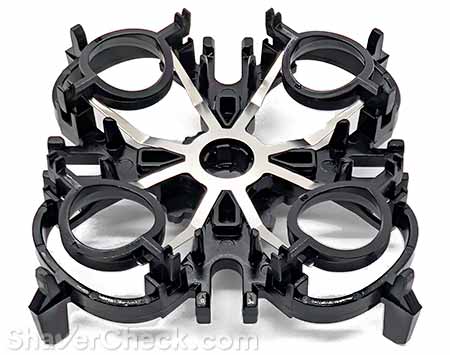
The Pitbull uses a similar system, and it makes a big difference in the real world.
The four Philips heads always stay in contact with the skin, the shaver never feels too harsh or aggressive, and the heads have a lot of give.
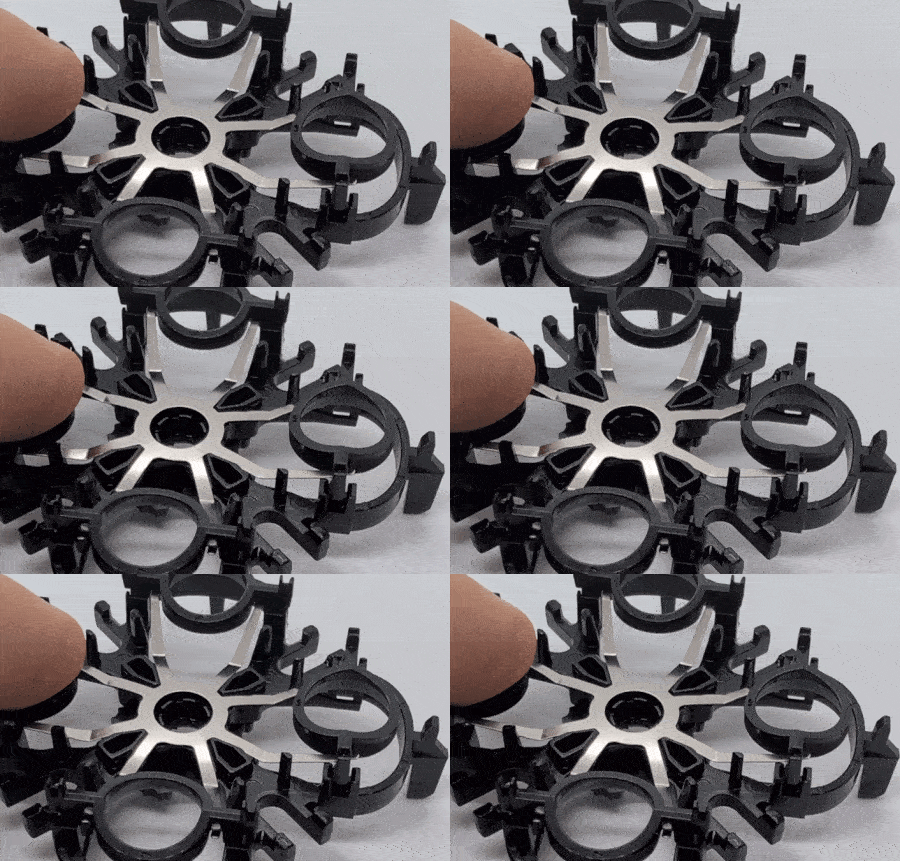
This means fewer chances of irritation and razor burn, and these are prerequisites for a smooth head shave.
I think most users will get a satisfactory close shave, maybe not quite razor blade close in some areas with thicker hair, but definitely close.
A foil head shaver with super thin foils will probably cut a bit closer, but it will take a lot more time to complete a head shave and will likely be more irritating.
With a 4-blade rotary, you can just whirl it across the scalp without worrying too much about hair grain/direction of growth.
Using circular, overlapping motions, you will most likely attack the hair against the grain no matter what, and that’s ideal for an effective and close shave.
The Head Shaver Pro is probably the fastest rotary machine of this type I’ve used, despite its bulkiness and weight.
I think the closeness is really great considering how fast and comfortable the shaver is.
You will be making major compromises when using, let’s say, a double-edge foil shaver (for the head).
For just a bit more closeness, such a foil razor will be much slower, more irritating and less enjoyable to use.
I think there are a couple of regular (face) foil shavers that would be worthy alternatives (with a couple of gotchas), and I will present them in the Alternatives section.
Comfort
Interestingly, Philips’ basic rotary heads are also among the more gentle and forgiving.
Without the Lift&Cut design, where the blade first raises the hair (which can feel like it’s yanking it), the cutting is super smooth.
I think the Philips Head Shaver Pro is on par with the Pitbull Pro in the comfort department.
You should only be more careful while shaving the back of your neck, in the sense that you would use less pressure.
On the crown and sides of the head, I don’t think you’ll have any issues at all.
The back of my neck is super sensitive and I constantly get lots of bumps if I use a more aggressive shaver (foil or rotary).
With this one, I didn’t have any major discomfort or irritation.
Considering how close this Philips can cut the hair, I think the comfort is remarkable, and arguably class-leading among other dedicated rotary head shavers.
Speed and effectiveness
As hinted throughout the review, the combination of four suspended heads, along with a powerful motor and the use of overlapping, circular strokes, makes the Head Shaver Pro a very effective and fast machine.
But as expected, the hair would need to be relatively short in order for (any) rotary or foil shaver to work optimally.
I think most men should be perfectly fine using the Head Shaver Pro anywhere from daily up to every 3–4 days.
This will of course depend on how fast the hair grows back.
But if you want to shave (a lot) less often than that, you will need to pre-trim your hair using clippers.
Or a multi-grooming trimmer like the Philips Multigroom 9000 or 7000.
Noise during use
Rotary shavers are generally quiet.
And compared to a foil machine, the Philips Head Shaver Pro is definitely quieter.
But by rotary shaver standards, it’s louder than most.
I think the reason is that fourth head.
I own many Philips shavers that use the same blades, but only have 3 heads, and are noticeably quieter.
And I know the motor is not the culprit, because if I run the Head Shaver Pro with the head unit removed, it’s whisper-quiet.
So the reason for the noise has to be the larger number of heads.
I’d say it’s maybe a tad louder than the Pitbull Pro and the Balder Pro, but overall very similar.
Grip and ergonomics
Because of its weight, size and lack of rubber surfaces, the ergonomics of the Head Shaver Pro could have been better.
With the conventional grip, the smaller Balder Pro with the super grippy and textured sides is easier to hold in a conventional grip.

And the Pitbull Pro with the generous cutouts in the body will give your fingers more room for a palm grip.
With the Philips Head Shaver Pro, you may feel them a bit too squeezed if your fingers are thicker.

I don’t think any of these are deal-breakers, and the Philips head shaver makes up for these shortcomings in other ways.
Shaving your face with the Head Shaver Pro
Apart from the different form factor, the Head Shaver Pro is essentially a Philips rotary shaver with one extra head.
So it should work just fine to shave your face as well.
And it does, but it definitely feels clunkier and not as manageable and user-friendly as a 3-blade Norelco rotary.
The blades themselves are quite basic, and while they work great for the soft hair on the head, facial hair is much coarser, so the performance isn’t stellar.
The comfort is great, but the closeness is similar to a very basic and inexpensive Philips Series 3000.
It will get the job done and if you can manage shaving below the nose and around your sideburns, you probably won’t need a second shaver for the face.
Personally, I would get that second shaver. The experience just won’t be enjoyable because of the large head and lack of finesse and control.
Replacement heads and upgrade options
The Head Shaver Pro (5000, 7000, and 9000 Series) uses the Philips HS740 replacement heads.
Philips HS740
These are very basic, single-track rotary heads, with only 9 individual blades per rotary cutter.

As we know, these blades feature a single-edge design, so there’s no Lift&Cut technology that we get on more advanced Philips heads.
Upon a closer inspection, the 4 heads bundled in the HS740 pack appear to be the same ones that Philips sells in the 3-pack SH30.
And this has a couple of very interesting implications.
First of all, there’s the durability, i.e., how long these heads last before needing to be replaced.
For the SH30 used on Philips’ entry-level face shavers (Series 1000, 2000, 3000), the official interval is 2 years.
However, for the HS740 (the 4-pack version), Philips says you should replace them every 6 months.
That’s really strange considering that the blades are exactly the same.
My guess is that their testing methodology is different.
For example, Philips might assume that you’re using the Head Shaver Pro daily, so the blades will need to cut a lot more hair, and thus they will wear out faster.
The frequency of shaving will however vary among different users.
The good news is that we’re getting the same blades as the ones in the SH30, so they are sturdy and reliable, despite the very simple design.
Important: the SH30 exists in two variations: wingless and winged (red arrows):
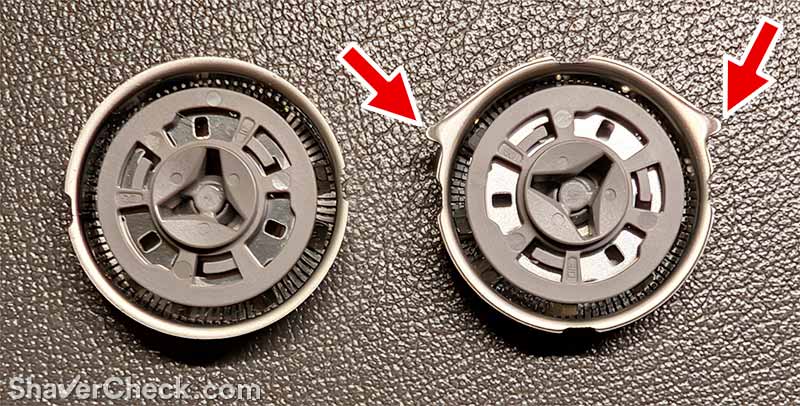
So if you found a great deal on the SH30 and want to stock up and use them on your Philips Head Shaver, make sure they’re the wingless model.
The winged SH30 will NOT fit.
Replacing the heads is super simple, you just remove the locking bracket by turning the tiny dial counterclockwise and it will pop out.

It’s very important not to intermix the guards and blades, especially after using the shaver for a while, as they are matching pairs.
If you do mix them, it will take a while for the blades to settle in, during which the cutting action may not be optimal. And the wear will be greater.
The second implication is related to upgrade options.
Upgrading the blades of your Head Shaver Pro
Philips shavers fitted with SH30 blades can generally be upgraded with better, more advanced rotary blades, even though officially they are not listed as being compatible.
And since the HS740 is essentially a wingless SH30 in a 4-pack variation, that opens up the door for some interesting upgrades.
But there’s a catch.
Just like the SH30, the better blades only come in a 3-pack, but you would need 4, as the Head Shaver Pro has 4 heads, not 3 like Norelco’s face shavers.
So you would need to buy two 3-packs (and be left with 2 heads you can’t use).
That inconvenience aside, the first and most logical upgrade option would be the SH71.

The SH71 heads are a clear improvement over the HS740/SH30 because they have more blades per rotary cutter (15 vs 9) and they feature a double-edge design (Lift&Cut).
The result is a more effective cutting action, fewer chances of the hairs getting yanked during a faster movement of the shaver, and possibly a closer shave.
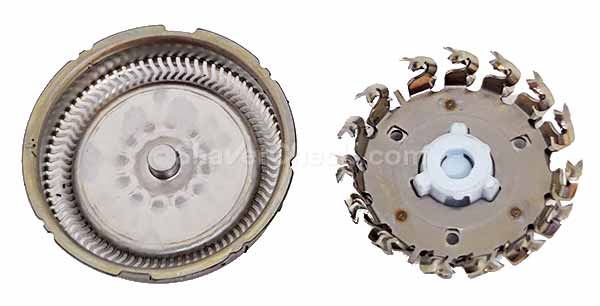
However, these are all improvements that would be less noticeable when shaving your head, as opposed to shaving your face.
So while you may notice an improvement, most likely to the time it takes to complete the shave, it will probably be a small one.
And considering the higher price and that you’ll need many SH71 3-packs to use all of them on your Head Shaver Pro, I don’t think it makes a lot of sense.
And it’s definitely not worth it to buy and use Philips’ range-topping blades, the SH91.
While these will also fit the Head Shaver Pro, they cost even more than the SH71 and are probably overkill for a head shaver.
The SH91 are dual-track, double-edge (Lift&Cut) heads with 24 individual blades per rotary cutter.

Specs-wise, these are the best rotary heads that Philips currently makes and are used on the Series 8000 and 9000 (including the range-topping i9000 Prestige Ultra).
But dual tracks and a high number of blades also need a lot of power, as the friction between the blades and guard will be a lot higher.
This means the head shaver will run slower, which can negate some of the potential gains.
So my opinion is that it’s just not worth it to invest in expensive rotary blades for your Head Shaver Pro.
I’d stick with the cost-effective HS740 (or the wingless SH30), and even stock up when I find a really good deal.
Cleaning and maintenance
I found the Head Shaver Pro to be one of the easiest to clean vs other rotary razors of this type.
- It’s fully waterproof and can be rinsed with tap water
- You can remove the blades and guards individually for a thorough cleaning (only when needed)
- The 7000 and 9000 Series include a practical rinse tub (I haven’t used it much)
In my experience, the best approach would be to clean your Head Shaver Pro with water after every use.
You can do that directly under the tap or via the rinse stand.
Here’s how it goes.
After completing your shave, turn the razor off and remove the front part of the shaving unit (that holds the four cutters).
There are two small grips on the sides of the frame, making it easier to grab without using your fingernails.
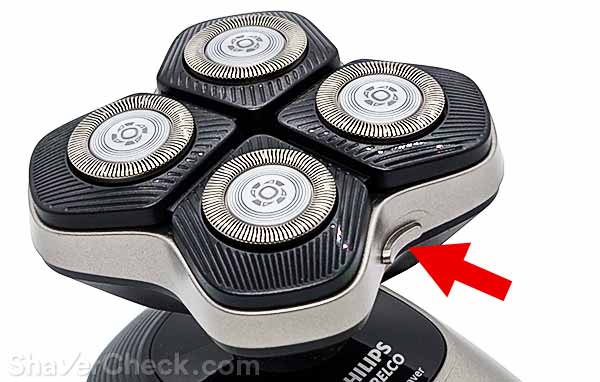
Once separated, generously rinse both the shaving unit and the hair chamber with lukewarm water:

Shake off the excess water (you can even very gently pat them dry with a towel without rubbing) and let them air dry.
I would leave the head unit detached from the shaver so that the moisture evaporates completely.
And that’s pretty much it.
Alternatively, you would fill the rinse tub with water, turn on the shaver and place it in the container for about 1 minute.

After that, you would remove the shaver, turn it off, and let everything air dry.
I didn’t use the rinse stand a lot; I find it a bit redundant, and I prefer to just wash the shaver with water.
I think it might be useful if you want (from time to time) to clean your Head Shaver Pro using Philips’ JetClean fluid or a third-party detergent-based solution compatible with Philips rotaries.
The solution will clean the heads more thoroughly and provide some lubrication.
You don’t need to do this, but it can only be beneficial.
If you notice some hairs stuck to the inner part of the shaving unit, you can use the brush to remove them.
Deep cleaning
Once a month (or even less frequently), it’s recommended to perform a so-called deep cleaning.
A deep clean might be needed to remove grime that got stuck to the blades or to the inside of the guards.
You would remove the locking bracket and clean each guard and blade pair individually (again making sure not to intermix them).
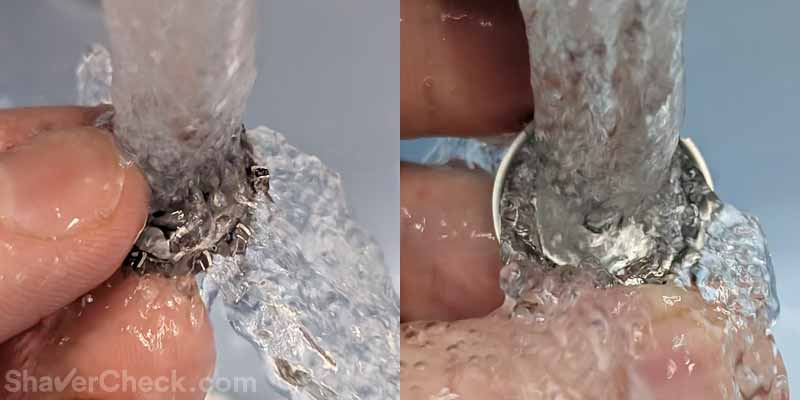
You can wash the guards and blades with water, and even use a wooden toothpick to gently scrape off any hardened dirt.
If you have a clipper spray or even Philips’ very own cleaning spray, you can apply the product on the clean heads for some extra lubrication.
That last part is not a must, and Philips doesn’t mention it in the user manual, but again, it certainly can’t hurt.
Battery life and charging
The 7000 and 9000 Series head shavers offer a solid 90 minutes of runtime from a single charge (same as the Pitbull Gold Pro).
The 5000 is still very decent with 60 minutes.
Philips has a great track record when it comes to battery life and battery longevity, which is yet another reason why I think the Head Shaver Pro is now the new go-to.
My 9000 Series has a 3-level battery indicator, which I find quite useful, so you’re less likely to be caught off guard by a low-battery warning.
All Head Shaver Pro models are fitted with Philips’ proprietary charging port.

In the package you’ll find a special cable with the Philips connector at one end and a USB-A at the other.
I think this is a decent solution in terms of practicality, as you can use any existing USB-A charger or a USB-A socket.

Of course, a USB-C port on the shaver itself would have been even better, but Philips still seems to cling to their proprietary port.
Charging from 0 to 100% takes about one hour and there’s a 5-minute quick charge function as well.

That will give you about 5 minutes’ worth of shaving from a 5-minute charge.
Overall, the Head Shaver Pro does really well in the battery department, with my only niggle being the lack of a USB-C port.
Takeaway: Should you buy the Philips Head Shaver Pro?
If you shave your head frequently and you want a close, smooth finish, I think the Philips Head Shaver Pro is one of the more compelling and safe options out there.
Philips Norelco Head Shaver Pro
The shaving performance is at least as good compared to its main competitors, while the durability and customer support are superior.
Even though it’s a large razor, the ergonomics are still good, and the shaving is excellent.
It’s a powerful, smooth, and easy-to-use shaver that will probably be the best choice for most users.
I think the 9000 Series is the most attractive package, with the discounted 7000 Series representing a viable, more affordable alternative.
And speaking of alternatives, here’s a quick rundown of the Head Shaver Pro’s main competitors.
Alternatives
Philips Head Shaver Pro vs Pitbull Gold Pro vs Balder Pro

These are the rotary head razors that would often make the shortlist of many potential buyers.
To me, the Head Shaver Pro is now the default recommendation for this type of shaver (thanks to its performance, reliability, and even price).
That said, all have their own pros and cons.
Here are a few things to consider that might help you choose one over the other.
Skull Shaver Pitbull Gold Pro (GX5):
- The comfort and closeness of the shave are similar to the Head Shaver Pro
- The Pitbull Gold Pro is probably the best ergonomically: size (of the shaving unit), weight, shape of the handle, etc.
- It is also one of the least reliable head shavers according to some user reports (mainly battery-related problems and even motors)
- Customer support is not very helpful or quick in resolving warranty issues
- Price and cost of ownership are similar to the Head Shaver Pro, but you might need to change the blades more often
- The head unit, especially the fitting with the drive shaft, is not as sturdy as the one on the Philips head shaver
- It is the most reasonably priced of all three
- The performance is still good, with similar closeness, but it’s not as comfortable as the other two
- The heads can’t be removed individually for a thorough cleaning
- The battery life is by far the worse and you will need to charge it a lot more often
- The 5-blade head is quite large, and the heads are not suspended on springs, so it’s not as enjoyable and effective as the Philips or the Pitbull
All things considered, unless the Pitbull or Blader Pro make a lot more sense (for a particular reason), I think the Philips is simply the better and safest option.
Foil (face) shavers
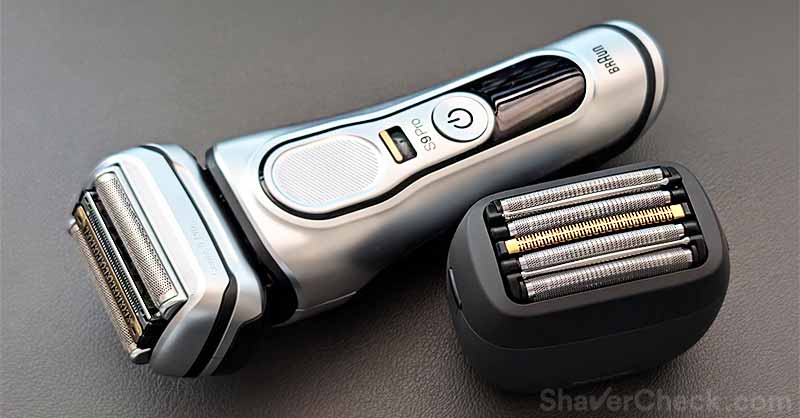
When it comes to using regular electric razors to shave your head, there are two that stand out in particular.
The first is the Braun Series 9 (PRO/PRO+).
This is a highly capable and versatile foil shaver, with 4 active cutters, that also happens to work brilliantly on both the face and head.
The 4 cutters stick out a lot, have a great range of motion, and move super smoothly, while the head pivots front to back, ideal for shaving a spherical surface.

The closeness is really good, and the comfort is just sublime.
It is however a regular electric shaver, with a conventional shape/handle, so it can be a bit awkward to shave the top and back of our head.
But if you want a single shaver to do both, this one is arguably the best compromise.
The second remarkable foil shaver would be the Panasonic Arc 5 Palm-sized.
This one is actually marketed as a travel shaver, but because of its compact shape and excellent performance, it works surprisingly well as a head shaver.

I think it cuts closer than even the Braun Series 9, but it’s not quite as forgiving (on the back of the neck).
On the rest of the head and on the face, it’s actually very comfortable.

The Panasonic replacement foil and blades are however pricey and the shaver itself is quite expensive.
But if those aren’t deal breakers, and you also travel a lot, it’s a worthy alternative.
That concludes my review of the new Philips Norelco Head Shaver Pro.
If you have any questions or you’d like to share your experience with your shaver, make sure to leave a comment below.
OK I wonder, what will give the most close shave for my head? really make it “the closest” in the market right now? cause I want to get that really “bald shine” kind of head, so?
I would still say a double foil shaver with very thin screens would be the electric machine that would give you the closest head shave, so something like the BaByliss FX2 or FX3, Andis ProFoil, etc. But with the caveats I mentioned in the review: shaving will take more time compared to using a rotary like the Philips, it won’t be as comfortable (I get serious irritation on the back of my neck) and the foils usually wear out quickly since they are super thin and there’s a lot of friction.
Pros and cons considered, for me the Philips head shaver seems like the better option to live with daily, even though the closeness is a bit more limited because of the thicker guards.
Sincerely,
Ovidiu
Thank you for your thorough review, Ovidiu!
I’ve tried this shaver, but actually don’t like it at all:
It really struggles on the back of my head, where my hair is still thicker and more dense. It always left small patched behind, no matter how long I shaved my head. I even tried the SH91 replacement blades, just for fun, but those just slightly improved the situation. One head shave took me around 10 minutes, which is way too long. When shaving my head wet with a razor, it takes me about 7 minutes, and when using other electrical shavers (like the Panasonic travel shaver), it takes me around 4 to 5 minutes.
A big con for me is also the fact it only has four bladed and that those blades are placed rather spaciously. There’s also quite a big margin between the blades and the edge, meaning it’s harder to shave around the ear.
I had high hopes for his shaver, but it just didn’t do it for me, unfortunately. I’m completely bald, so maybe that’s why my experience was different from yours.
Overall, I would give this just 2.5 stars. It’s nicely built, and the shave itself is comfortable, but not thorough at all, and the whole shaver itself is quite bulky.
I’m now trying the Baldwin shaver from an Austrian company and like this one a lot. Not only is it a lot cheaper, the shave is much closer, and replacement blades are also cheaper. I live in Germany, and a set of four replacement blades for Philips costs 35 €. One replacement head for my Baldwin shaver costs 15 € (and the head consists of 7 blades). A set of three replacement heads costs the same as a set of four replacement blades from Philips.
I only have the Baldwin for a couple of weeks now, so I can’t say how long the blades will last, but according to the manual, they shoud last about 6 months, so as long as the ones from Philips. The shaver itself is also cheaper, but doesn’t come with any storage bag (this one costs extra).
I hope my comment didn’t sound like an advertisement for Baldwin, I just wanted to share my experience and give a quick cost comparison for replacement parts.
Hey Nico,
Thanks so much for taking the time to share this.
It seems like something about the Philips head shaver just didn’t work out. Most of the time the spaced out heads should not cause a significant drop in effectiveness when shaving the head. Also there’s quite a bit of space between my ears and the hairline so for me the larger plastic rim around the cutters wasn’t an issue, but I do see this being a problem for other users. I appreciate the detailed feedback a lot, and it definitely helps with my perspective on this shaver.
The Baldwin rotary looks great specs-wise. I’ve never used one before, so right now I couldn’t say how it compares to the Philips shaver. I will certainly buy one and review it. The reliability, support and availability of the Philips Head Shaver Pro did matter a lot for me when coming up with a conclusion and I think those aspects will ultimately be key for the Baldwin as well. Philips does have a big advantage in this regard.
Sincerely,
Ovidiu
Your review was very informative and comprehensive, I enjoyed every word, and I must say that everything was on point, u have the 7000 for 6 month and I’m never going back, others used to iritat my skin after a few passes and because if that had to wait a few days to allow the skin to come down.with the Philips I can go freely, even daily, I now shave every 2 days.
Hey Natan,
Many thanks for taking the time to share your experience with the 7000; glad it turned out to be a great match.
Sincerely,
Ovidiu
Thanks for the review. I have been using Philips head shaver since shortly after your review was posted. I love it. Very comfortable and close enough for me. I recently started face shaving with it and am
impressed. It’s a little bulky but provides a better shave for me than the current 7000 series Phillips Norelco. Will the i9000 series provide an even closer shave? Will they be as comfortable?
Eric
Hi Eric,
Thank you for the comment.
When shaving your face, I think an i9000 Series, especially the Prestige Ultra would provide a better shave, closer as well in most cases. But despite the better performance and the superior heads, I don’t think it’ll be an overall better option as a head shaver. The ergonomics of the i9000, the price (of the shaver itself and of the replacement heads), the specifics of head shaving (larger surface, thinner hair) make it difficult to recommend over the Head Shaver Pro.
Sincerely,
Ovidiu
Hi Ovidiu,
I have been using a 5000 series for a couple of years and find it very well made and very efficient.
I must admit though, I have very fine hair so it doesn’t have to struggle as I guess with other hair types.
I’ve just bought my first replacement 4 pack of HS 740 heads from the USA on Amazon Prime for a little over AU$50. It took a little finding and I’ve opted for the genuine Philips heads. Just not convinced at ‘compatible’ heads.
I much appreciated the detail you covered in your article.
Thank you,
Cheers from Australia
William
Hi William,
Thank you for the comment. I think you made the right decision; I’ve had only poor experiences with compatible heads in the past, and even though the price might seem appealing, they’re just not worth it. The performance is not satisfactory, and they get blunt very quickly.
Sincerely,
Ovidiu